BidMatch
AI pricing and autonomous bidding that increases profitable freight wins with fewer people in the loop.
Product walkthrough
Freight marketplace
Start with the available work, expected margin, and predicted probability of winning.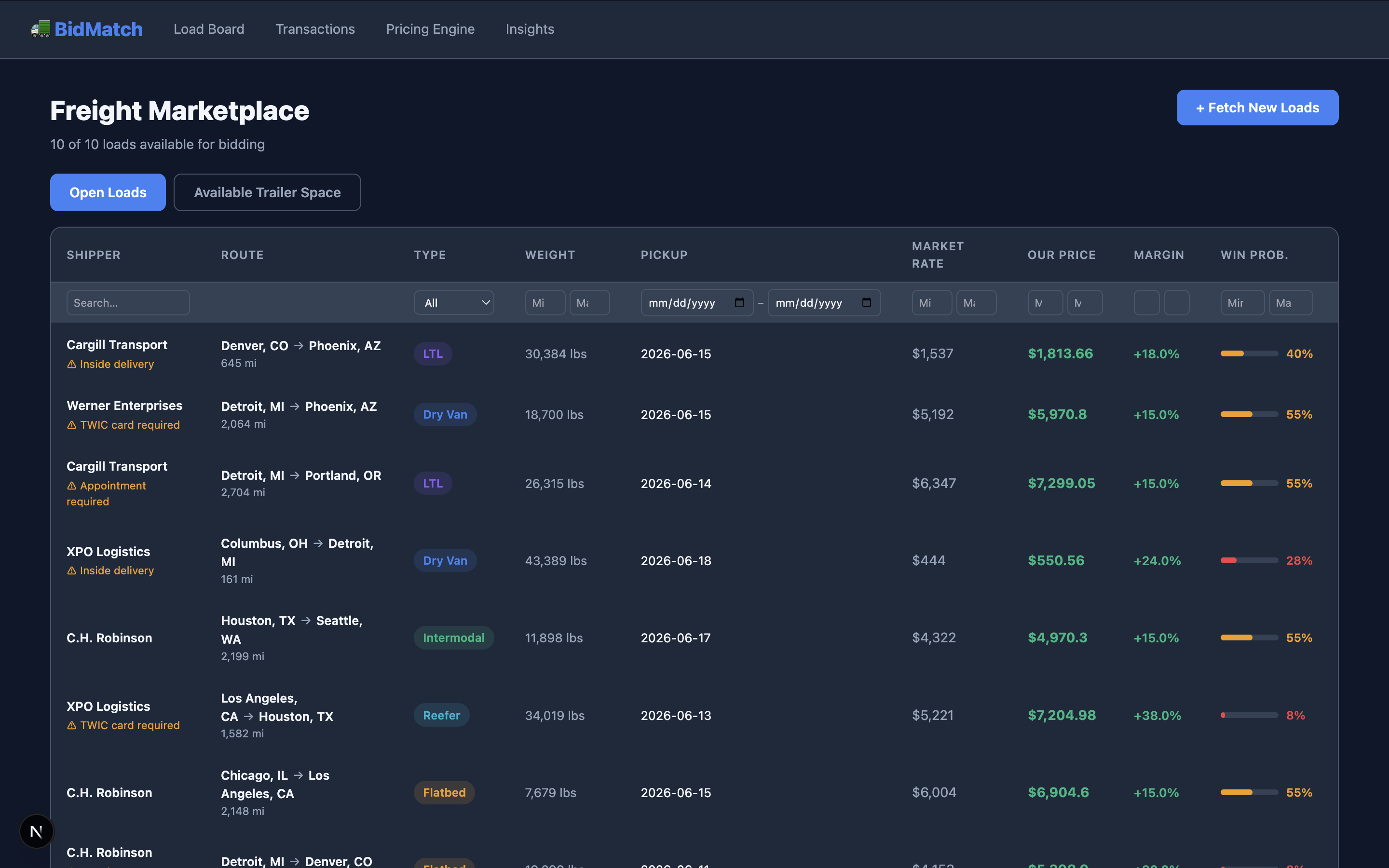
Outcome
Maximize margin and revenue by pairing AI price and win-rate optimization with governed autonomous biddingInnovation
An explainable AI decision system that optimizes expected profitable wins and executes approved bids within margin, service, and authority guardrailsStack
AI Pricing Optimization · Win-Probability Model · Rules Engine · Freight Marketplace · Autonomous Bidding · Transaction AnalyticsHow it works
BidMatch is an AI freight-pricing and autonomous-bidding workspace that helps transportation teams win more profitable work with fewer people in the loop.
It combines a live freight marketplace with an explainable AI pricing engine. For each shipment, AI weighs market rate, recommended ask, floor price, target margin, available discount room, profit at ask, and predicted win probability to optimize for the best expected margin and revenue—not merely the lowest price or the highest chance of winning.
Within approved commercial guardrails, BidMatch can bid autonomously: pursuing backhaul opportunities on behalf of shippers and optimizing freight decisions on behalf of consignees. People focus on policy, exceptions, and higher-value negotiations while the system executes repeatable decisions at market speed.
The Challenge
Load pricing is an operating decision made under time pressure. A team needs to stay competitive without accepting work that erodes margin, breaks a service constraint, or ignores a meaningful pattern in prior bids.
- Market rate alone does not account for shipment-specific cost and risk.
- Negotiators need a defensible floor, not a vague recommendation.
- Pricing exceptions such as refrigerated freight, hazmat, expedited pickup, long-haul distance, and shipper relationships must be applied consistently.
- Phone conversations and counters need to become structured transaction evidence.
- Leaders need to understand how pricing policy affects bid velocity, margin, and win probability.
- Too many routine bids still require a person to price, approve, and submit work that can be safely governed by policy.
The BidMatch Approach
BidMatch turns the pricing process into an AI decision and execution system.
Available freight load
  ↓
Shipment facts + market rate
  ↓
AI price, margin, and win-probability optimization
  ↓
Ask price + floor + margin guardrails
  ↓
Autonomous bid or governed human negotiation
  ↓
Win, margin, and revenue evidence for the next decision
The product’s high-contrast operational interface makes the logic visible. Green highlights profitable price positions, amber flags constraints and negotiation risk, and a clear rule table shows exactly why a price changed.
Core Product Surfaces
1. Freight marketplace
The load board presents open freight opportunities in one decision-ready table: shipper, lane, equipment type, weight, pickup date, market rate, BidMatch price, margin, and win probability. It shows where AI sees the strongest expected return—not simply the most available work.
Operational exceptions—such as inside delivery, appointment requirements, or a required TWIC card—stay attached to the opportunity. That lets a broker or carrier evaluate the commercial opportunity and execution constraints together rather than discovering the risk after the bid is submitted.
2. Pricing engine
The pricing engine gives operators a governed place to define and inspect the policy behind each AI-priced quote.
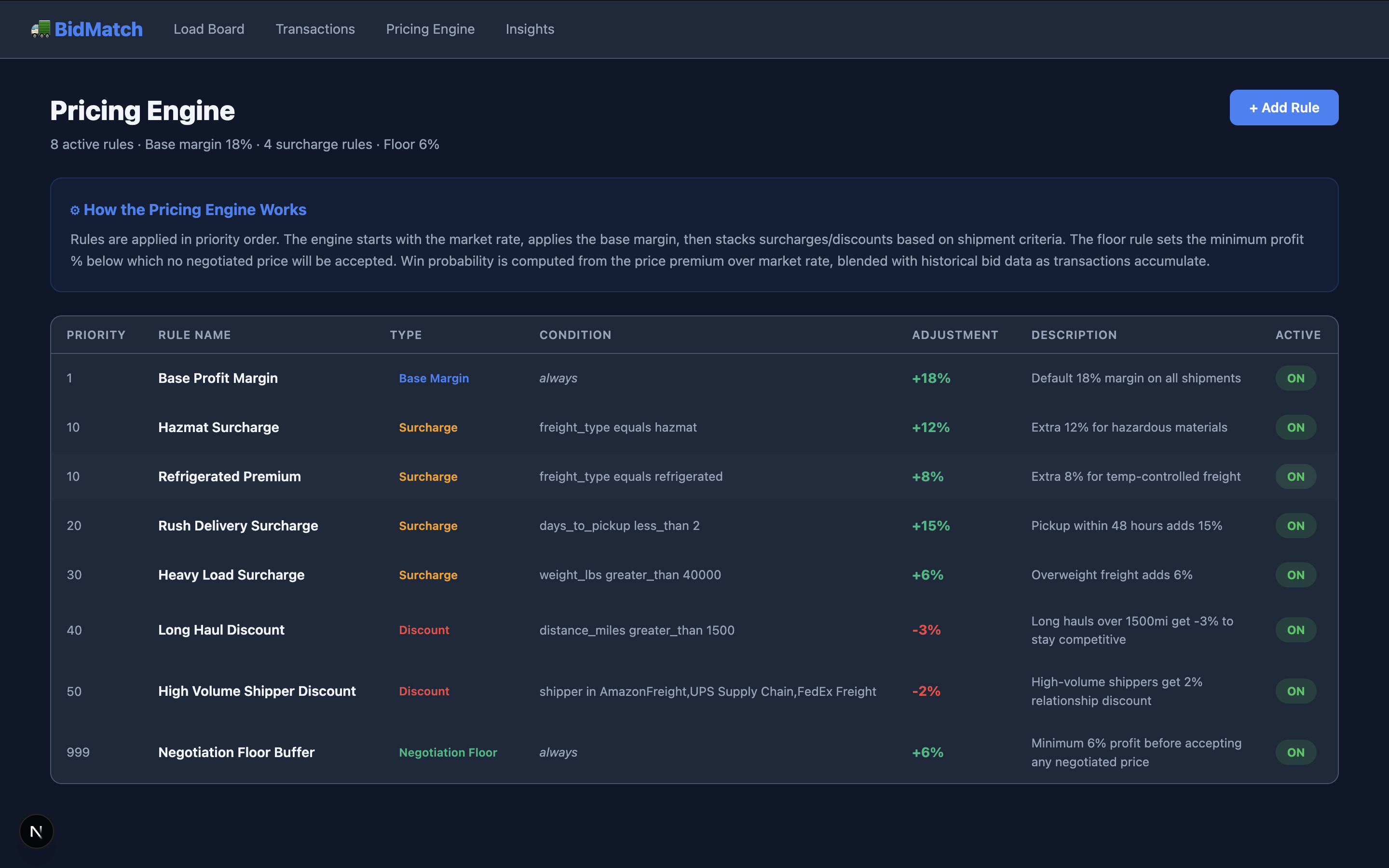
Rules are applied in priority order. AI starts from market rate, establishes a base profit margin, then applies adjustments based on shipment conditions and evaluates the price against the likelihood of winning. A negotiation-floor rule establishes the minimum acceptable profit position before a discounted or countered price can be accepted.
The rule table makes every active policy inspectable:
- Base margin establishes a default target across shipments.
- Surcharges protect for conditions such as hazmat, refrigerated freight, short-notice pickup, or heavy loads.
- Discounts keep prices competitive for long-haul and high-volume shipper scenarios.
- Negotiation floor protects a minimum profit threshold regardless of the discount conversation.
3. Rule authoring and change control
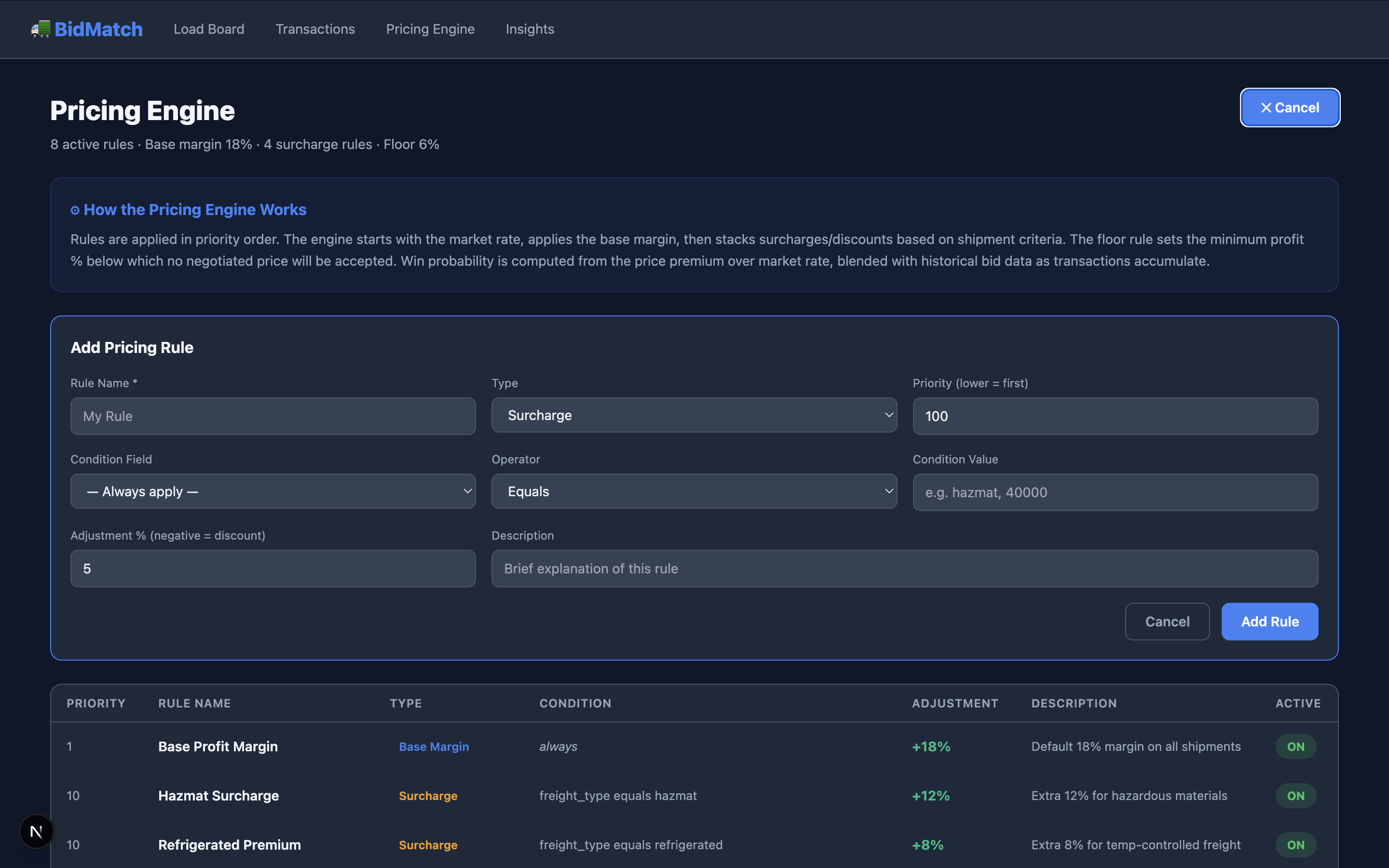
Pricing policies need to evolve without becoming opaque. BidMatch supports rule creation and editing through structured fields for priority, rule type, condition field, operator, condition value, adjustment percentage, and a plain-language description.
The rule authoring view gives business owners a controlled way to translate pricing strategy into reusable logic while leaving a readable audit trail for operations and technology teams.
4. Autonomous bidding and shipment negotiation
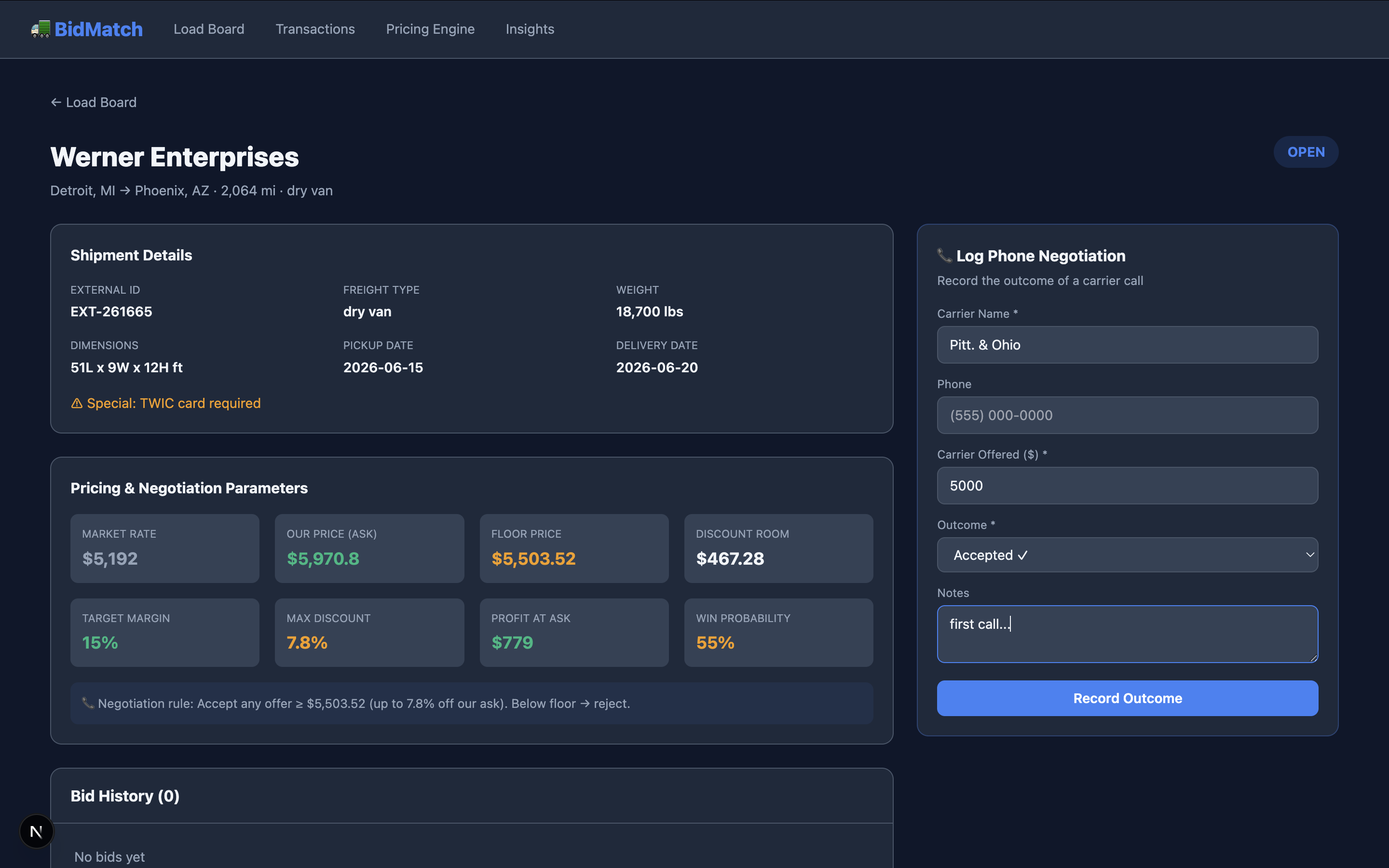
The load detail view connects commercial data to the actual negotiation or autonomous bid.
For an individual shipment, the workspace shows core freight facts alongside pricing and negotiation parameters: market rate, ask, floor, discount room, target margin, profit at ask, and win probability. The bidding rule is stated plainly—autonomously accept or submit a qualifying bid, counter within the permitted range, escalate an exception, or reject a price below the floor.
For shippers, the system can pursue backhaul bids that meet pre-approved commercial conditions. For consignees, it can optimize freight assignments against cost, service, and margin objectives. Phone negotiations can still be logged directly against the load, while bid history retains carrier, bid, counter, source, status, notes, and time so every automated or human outcome becomes data rather than an isolated conversation.
System Design
BidMatch system

Load board + shipper context + market-rate input
  ↓
Shipment normalization and constraint detection
  ↓
AI price, win-rate, and margin optimization
  ↓
Ask, floor, margin, and win-probability calculation
  ↓
Autonomous-bid workflow + human exception handling + bid history
  ↓
Transaction analytics and pricing-policy refinement
- Market layer: Brings available loads, shipper context, lane details, equipment needs, and market rate together.
- Decision layer: Evaluates prioritized pricing rules, win probability, and expected return while exposing the inputs behind every recommended ask and floor.
- Execution layer: Autonomously submits, accepts, or counters bids within approved guardrails; routes exceptions and high-value negotiations to people.
- Learning layer: Builds transaction history that continuously improves pricing calibration, rule design, and win-probability estimates.
Why It Matters
For transportation leaders, BidMatch turns pricing policy into a measurable operating system that grows margin and revenue instead of a collection of tribal rules and spreadsheets.
For operations teams, it removes people from routine pricing and bidding decisions while preserving clear margin, service, and authority boundaries.
For technology teams, it creates an explainable decision record: the market input, applicable policy, AI calculation, autonomous or human action, and result remain connected. That foundation supports continuous improvement without sacrificing commercial control.