REST GW
Registry-Driven REST and MCP Gateway for Governed AI Execution
Outcome
Give AI clients one policy-governed path to approved APIs without exposing endpoint topology or bypassing operational controlsInnovation
One registry and policy pipeline governs both REST invocation and MCP tool executionStack
Fastify · MCP JSON-RPC · Workflow Registry · Policy Engine · DMZ Proxy · RedisWalkthrough
A request becomes an approved workflow
Follow the negotiation from client intent through registry, policy, and invocation.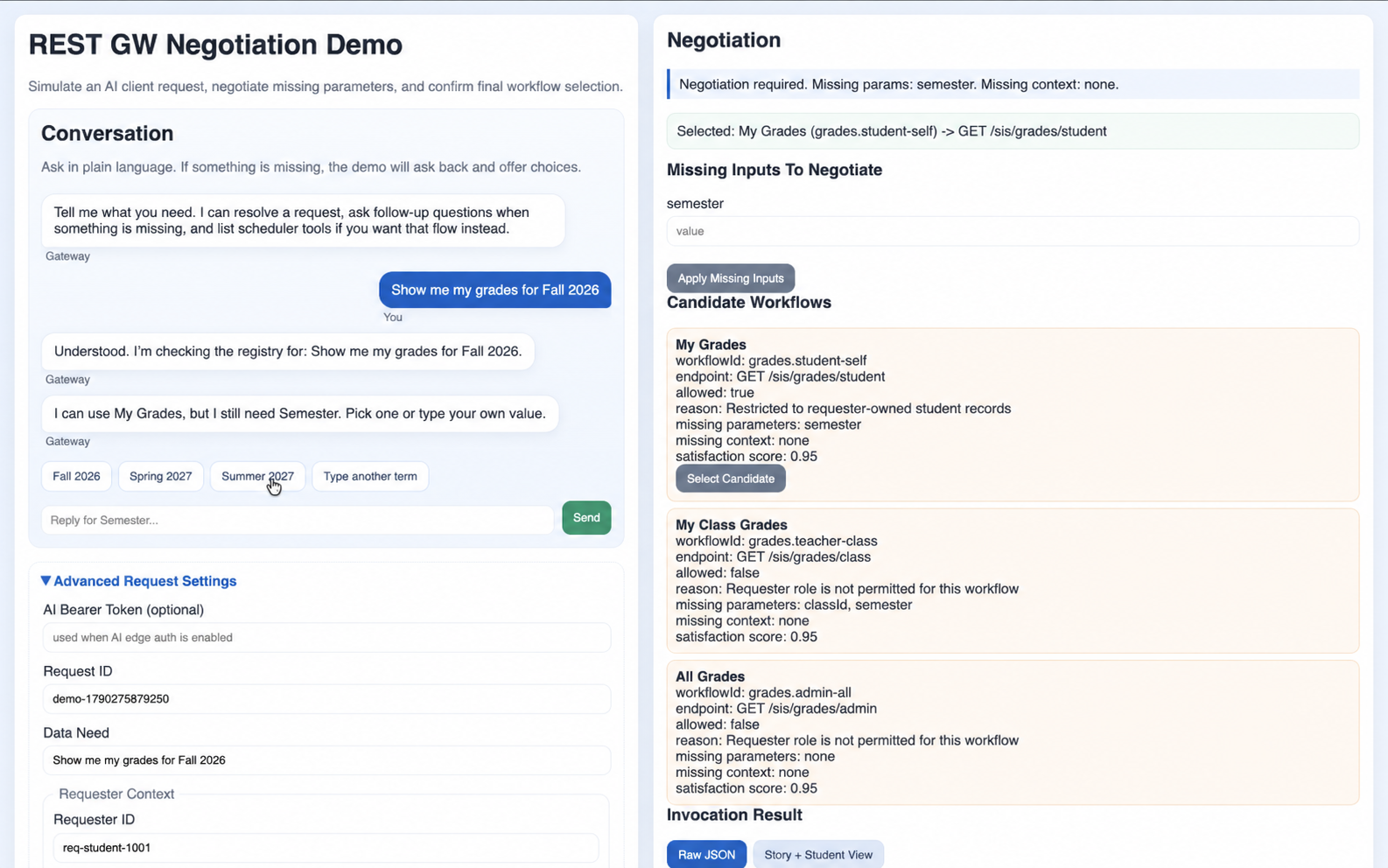
The AI client states the data need in ordinary language.
The gateway matches intent to approved, bound workflows.
Only the missing semester input is requested from the client.
Candidates reveal allowed paths and explain rejected alternatives.
The selected workflow proceeds through the governed execution path.
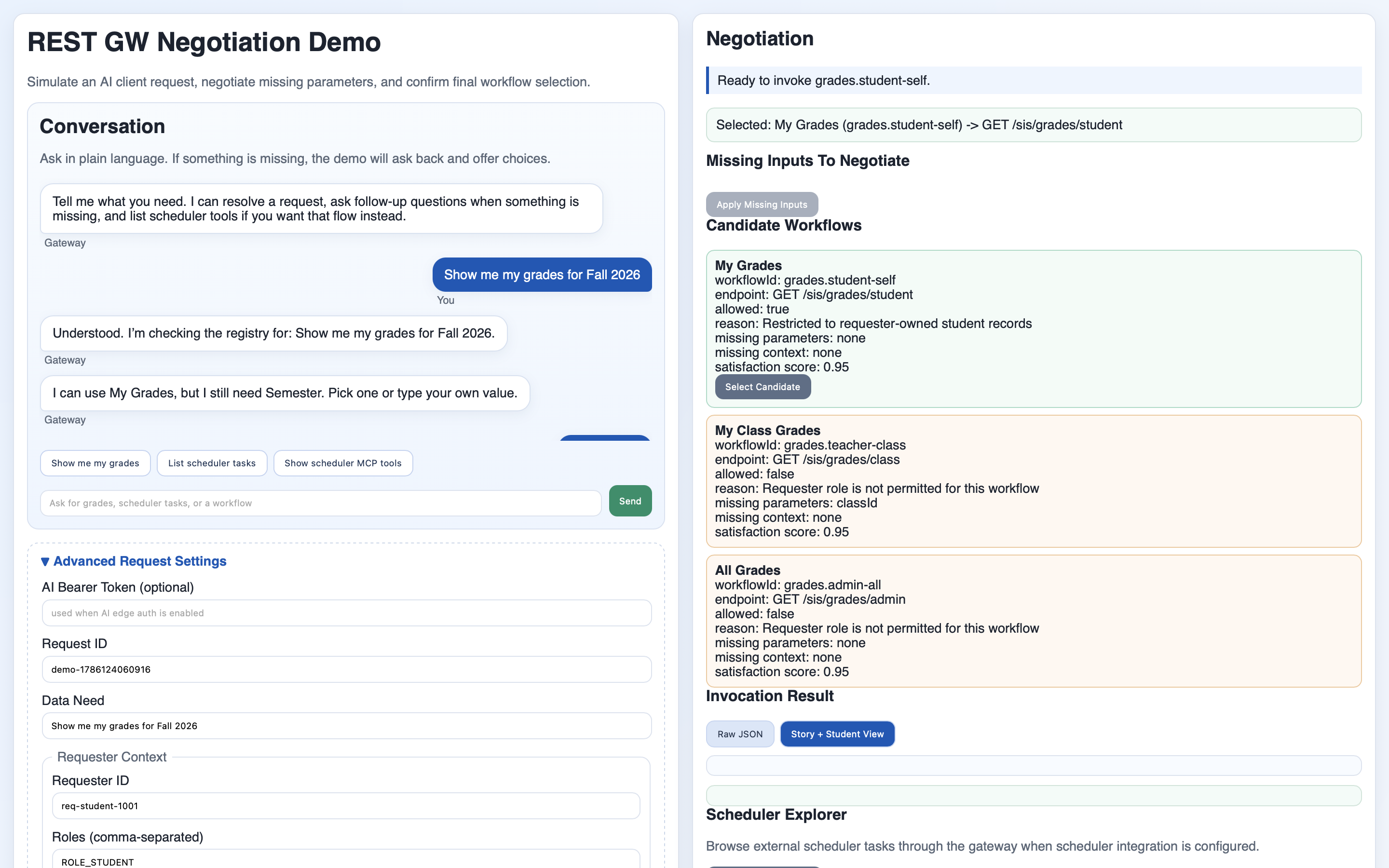
REST GW is a registry-driven gateway that converts an AI client’s intent into a controlled call to an approved API workflow. It is built for environments where the AI layer must use tools and data services without receiving direct access to network targets, credentials, or internal topology.
The gateway exposes both conventional REST routes and an MCP-compatible JSON-RPC surface. Those are not separate control systems: each path resolves against the same production registry, evaluates the same policy constraints, uses the same endpoint bindings, and records the same audit trail.
The Challenge
- AI clients should not choose backend IP addresses or paths at runtime
- Tool availability must reflect approved workflows, not whatever an agent can discover
- Identity, role, and data scope must travel with every invocation
- Operators need a replayable record of the workflow, endpoint binding, and outcome
The Gateway Approach
REST GW makes the execution path explicit.
- Authenticate the AI client and recover caller context.
- Resolve intent to candidate workflows in the production registry.
- Evaluate policy and enforce role- and identity-scoped filters.
- Bind execution to an install-time-approved endpoint, not a caller-supplied target.
- Forward through the DMZ proxy with request signing and sticky-session handling.
- Record binding and audit evidence for review and incident analysis.
Technical Architecture
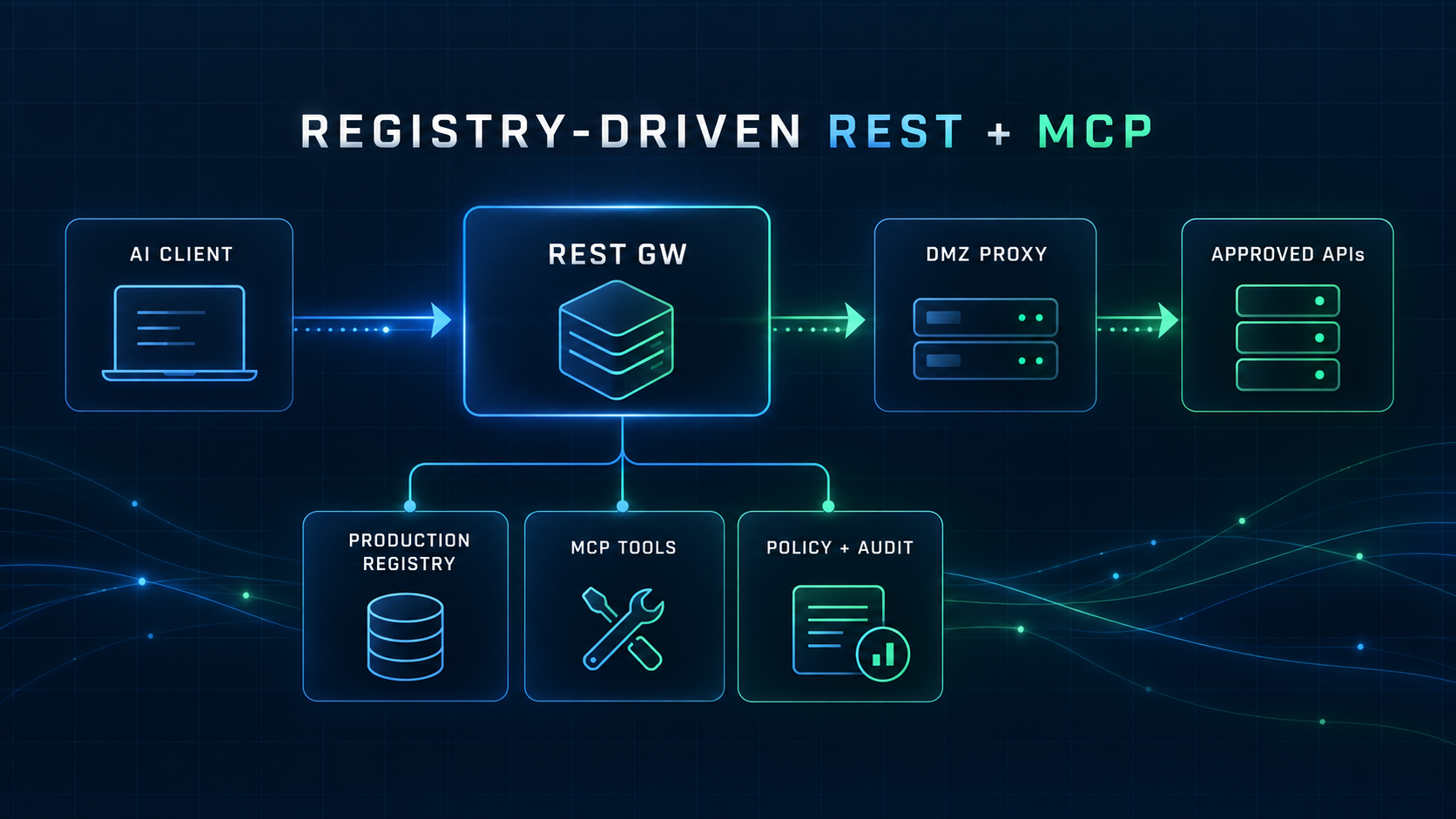
REST GW: governed REST and MCP execution
HTTPS requests carry authenticated identity and intent—not raw downstream targets or credentials.
Resolves a request against approved workflows, applies role and scope filters, then binds it to a managed endpoint.
Uses signed forwarding and sticky-session resolution to reach only sanctioned downstream API paths.
The REST and MCP paths share the same registry, policy, endpoint-binding, proxy, and audit pipeline.
- Registry-driven routing: the production registry describes approved workflows, required parameters, and route policy. Install-time endpoint bindings map those workflows to sanctioned proxy paths.
- MCP tool surface: MCP
tools/callrequests use the same workflow registry and policy enforcement as REST, so tool access cannot drift away from API governance. - Protected execution path: the gateway signs traffic for the DMZ proxy, resolves sticky sessions through Redis or memory, and never trusts a caller-provided network destination.
- Reviewable operations: request-to-endpoint bindings and audit events preserve the decision chain from client intent to downstream response.
Core Capabilities
1. Shared Policy Enforcement
Policy is evaluated at request time for every REST route and MCP tool call.
- AI client authentication through bearer or HMAC credentials
- Workflow role checks and identity-aware self/teacher/admin scopes
- Enforced request filters that restrict downstream result sets
- Required-parameter validation before proxy forwarding
2. Registry and MCP Tool Governance
The production registry is the source of truth for what can be executed. MCP is an access surface over that same control plane, not an alternate path around it.
- Workflow discovery and resolution from structured client intent
- MCP JSON-RPC tool calls mapped to approved workflow IDs
- Endpoint selection from install-time bindings rather than client configuration
- One consistent policy and audit contract across REST and MCP
3. DMZ Execution and Operational Evidence
The proxy path is designed to keep downstream access controlled and explainable.
- Signed gateway-to-proxy forwarding with an allowlisted target set
- Sticky-session handling for compatible downstream systems
- Request binding records that relate caller intent to its resolved endpoint
- Append-only audit events for authorization and execution outcomes
Why It Matters
AI systems become easier to scale when their tool layer is stable, observable, and governed.
REST GW makes the registry—not the agent prompt or client configuration—the authority for execution.